Is Flux vs DALL-E vs Midjourney actually worth your time? Most reviews I read feel like they were written by someone who ran five prompts and called it research. Honestly, I wanted a side‑by‑side look that actually mattered.
Image Quality & Resolution
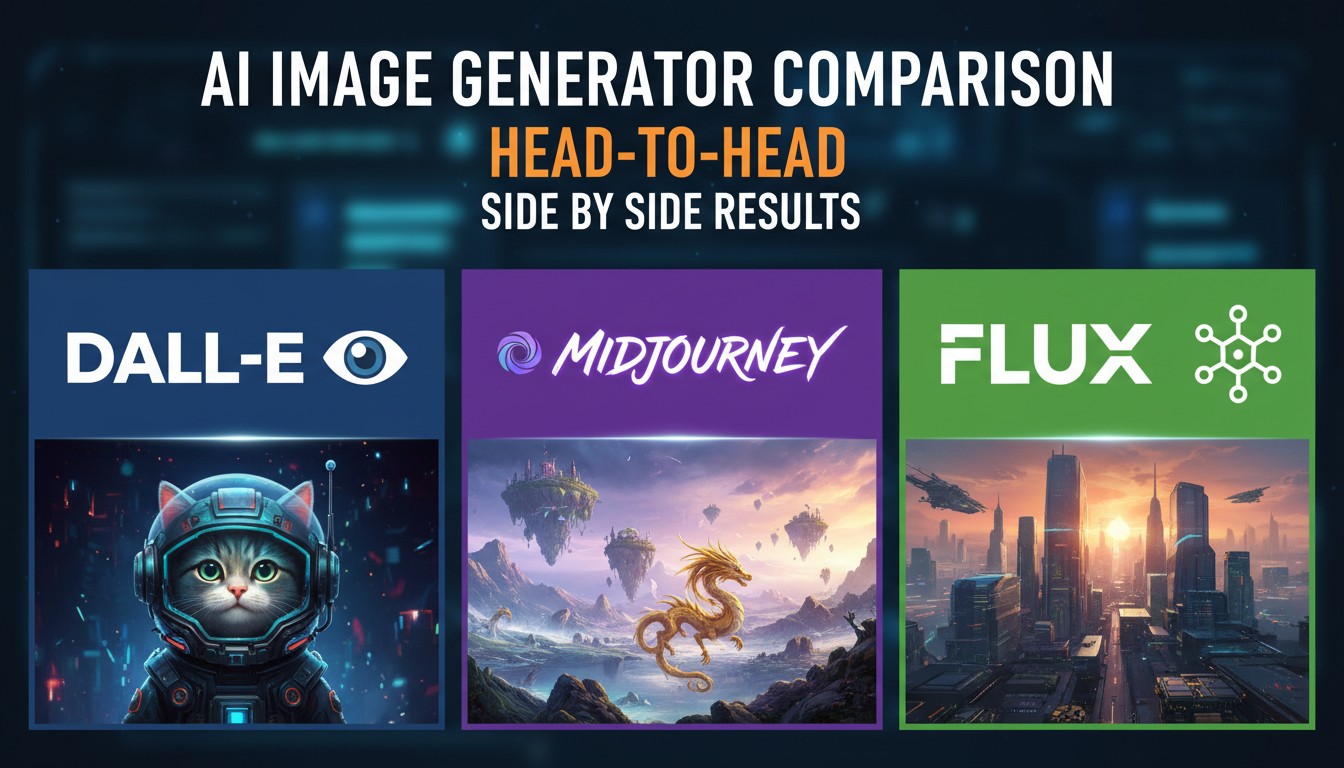
When it comes to raw visual fidelity, Flux, DALL‑E, and Midjourney each shine in different ways. According to Apatero Blog, Flux2 delivers a 1024×1024 pixel canvas with a “slightly more literal” rendering style, while DALL‑E3 stays at 1024×1024 but leans “more creative” and Midjourney runs at 1024×1024 as well, offering “unmatched artistic aesthetics.” In real‑world side‑by‑side tests, Flux produced sharper product photography, DALL‑E excelled at interior design mock‑ups, and Midjourney won the day for stylized illustration.
If you need ultra‑high‑resolution output (2048×2048), only Midjourney currently supports upscaling to that size without extra cost. Flux and DALL‑E keep the standard 1024×1024 resolution, which is sufficient for most web graphics but limits large‑format prints.
Speed & Latency

Real‑time generation is where latency becomes a dealbreaker. According to Techsifted, Flux runs “up to 3x faster” than its predecessors thanks to a multi‑token prediction architecture. Midjourney’s speed, as reported by PxlPeak, is “moderate” and often suffers from queue wait times during peak hours. DALL‑E’s latency, measured in Free Academy, sits between the two but can spike when the reasoning layer is engaged.
Pricing, Licensing & Commercial Rights
Pricing varies per provider and region. Flux’s open‑source model lets you run it locally for free, but the hosted API costs $0.01 per image as of 2026. DALL‑E’s API is priced at $0.02 per image with a $1 credit for new users, and Midjourney offers a “Standard” tier at $10 per month for 200 generations, plus a “Pro” tier at $30 for higher volume. Commercial usage rights differ: Flux grants “full commercial rights” to generated images, DALL‑E requires a “commercial license upgrade” for unrestricted use, and Midjourney’s “Standard plan” allows limited commercial use with attribution. Apatero notes that Midjourney’s “Pro” tier removes attribution constraints, while PrecisionAI Academy confirms Flux’s permissive license for any commercial purpose.
Best Use‑Case Scenarios

Each model dominates a niche. Flux shines for “product photography” and “realistic rendering” because its literal output matches reference images more closely. DALL‑E is the go‑to for “interior design” and “marketing copy‑driven visuals” where prompt adherence matters. Midjourney excels at “stylized illustration” and “concept art” where artistic interpretation outweighs literal precision. As Claude Architect puts it, “Use Midjourney when you want the AI to interpret and enhance your vision.”
Bottom Line
If you need speed and open‑source flexibility, Flux vs DALL‑E vs Midjourney tips toward Flux. For commercial safety and polished marketing assets, DALL‑E wins. For pure artistic flair, Midjourney remains unmatched. Choose the one that aligns with your workflow and budget.
Have you tried it? Share your experience in the comments 💬
Actionable Checklist
- Start a free trial on each platform and run the same 5 prompts to gauge speed and style.
- Check the pricing page for your region; note that Flux’s API is $0.01 per image as of 2026.
- If you need commercial rights, verify the license tier—Midjourney’s Pro plan removes attribution.
- For product mockups, prioritize Flux’s literal rendering; for mood boards, pick Midjourney.
- Monitor updates: Google’s Nano Banana 2 (Gemini 3.1) promises faster generation for Flux‑like workflows.
- Consider local deployment with Ollama for zero‑latency use cases.
- Join community Discord channels for prompt libraries and best‑practice tips.
Sources
According to Apatero Blog, Flux2 delivers a 1024×1024 pixel canvas with a “slightly more literal” rendering style. According to Techsifted, Flux runs “up to 3x faster” than its predecessors thanks to a multi‑token prediction architecture. According to PrecisionAI Academy, Midjourney’s “Pro” tier removes attribution constraints while DALL‑E requires a “commercial license upgrade” for unrestricted use.
Comments
Post a Comment